Insights
/
feb 16, 2025
How Much Does AI Automation Cost vs. Hiring Employees?
/
AUTHOR

Emil Visser

How Much Does AI Automation Cost vs. Hiring Employees?
The economics of AI automation cost vs hiring employees flipped quietly over the last 18 months. A targeted automation typically costs €3,000–€30,000 to build and €0–€500 a month to run. A full-time hire at a European SME costs €40,000–€75,000 a year all-in, and break-even on a well-scoped automation lands inside six months.
If you’re staring at the same backlog every Monday, invoices, document chases, support tickets, the reflex is to hire. That used to be the right move. In 2026, for most repeatable admin work, it isn’t. The software exists, it works in production, and year one comes in under a single quarter of payroll.
What does AI automation actually cost to build?
Three numbers matter: the build, the run, and the rework.
The build is where most of the money goes. A small pilot like an FAQ chatbot or a one-step extraction job runs roughly €3,000–€8,000. A focused workflow with two or three steps, say document collection with validation and a CRM sync, costs €8,000–€20,000. Anything that touches multiple systems and needs custom logic sits in the €15,000+ range. SmartDev’s 2025 SME breakdown puts a “department-level solution” in the same zone, and our own client deployments confirm it.
What stops the total ballooning is that the AI model itself is rented, not built. You’re not training a model from scratch; you’re calling a hosted one — OpenAI, Anthropic, Mistral, Google. The model gets better every few months at no extra cost to you. Five years ago this same workflow would have meant a six-figure custom build. Today, the heavy lifting sits on the API side, and you’re paying for orchestration, prompt design, and integration.
Monthly running costs are smaller than most clients expect. The bulk of our deployments live on €100–€400 a month: API tokens for the AI calls, a no-code orchestrator like n8n, plus a small database and an observability layer. Heavier voice or video workflows can push past €1,000 a month, but those are edge-cases for SMEs.
Rework is where SMEs underbudget. Plan for one to two hours of engineering a month per workflow once it’s live. Most of it is upstream changes you didn’t ask for: a partner adds a new field, a CRM gets re-mapped, a regulator changes a form, an LLM provider deprecates a model. Budget €100–€500 a month for any workflow you care about.
A useful rule of thumb: total year-one cost for one focused automation lands between €5,000 and €30,000 all-in. Year two drops below €5,000 if the workflow is stable.
What does one employee really cost in 2026?
Salary is the smallest part of the bill.
In Germany, employer contributions add roughly 20–23% on top of gross pay, so a €60,000 salary becomes €72,000–€74,000 before you’ve added a laptop, software, or any bonus. France runs hotter at around 45% overhead. The Netherlands sits near 19%, Poland around 22%, the UK 20–25% after the 15% Employer NIC that took effect in 2025. Sources are public: Accace’s EMEA cost infographic, Eurodev’s per-country guides, and each country’s tax authority.
Then there’s recruitment. The average European cost-per-hire is roughly €4,300 (about $4,700 per FMC Group’s 2026 global figures), and external recruiters take 15–25% of first-year salary if you can’t fill the role internally. Onboarding to fully productive runs three to six months, during which the new hire is still costing you full payroll while producing a fraction of the eventual output.
A worked figure for an admin or coordinator role at a Western European SME:
Gross salary: €35,000
Employer contributions at 22%: €7,700
Equipment and software: €2,000
Recruitment cost: €4,500
Onboarding lost productivity (3 months at 50%): €4,400
That comes to €53,600 in the first year, before sick days, holiday cover, training budget, or any kind of raise. For senior roles the multiplier is higher. A €60,000 base usually crosses €85,000 once you factor in every line.
Headcount is also sticky. Once you hire, you absorb the full cost during slow months. An automation costs the same in your busy quarter and your quiet one. For seasonal businesses, that swing matters more than the top-line numbers.
AI automation cost vs hiring employees: the side-by-side
Here’s the comparison we put in front of clients when they’re weighing a hire against an automation for the same workflow.
Press enter or click to view image in full size
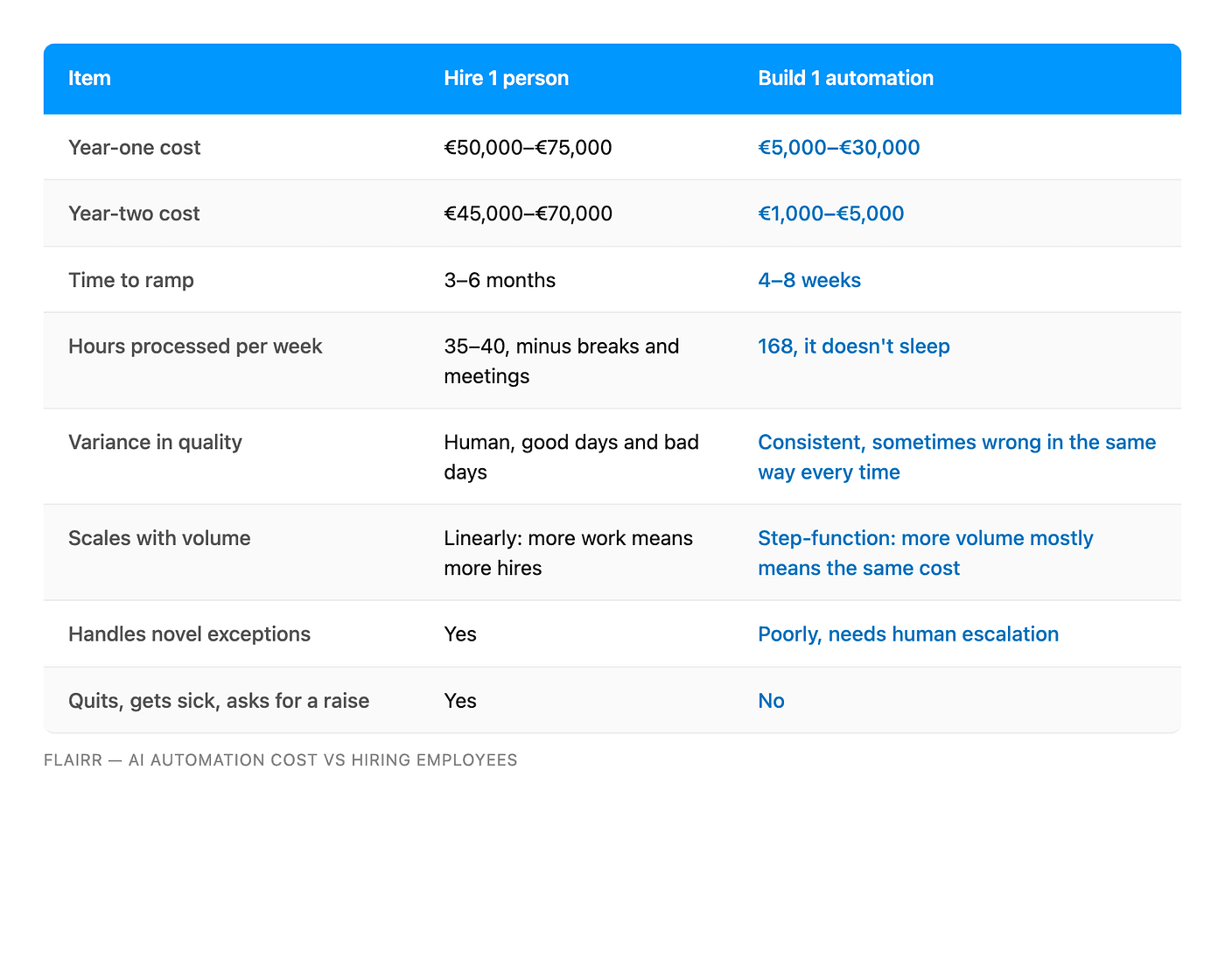
Two things stand out. Year one already favours automation, and year two is dramatically cheaper. The other point most articles miss: an automation replaces the repeatable, rule-based share of a person’s job, not the whole role. By our measurement, that’s 30–60% of a typical SME admin role.
Where hiring still beats automation
We turn down work for this reason every month, so it’s worth saying clearly. Hire, don’t automate, when:
The work needs ongoing relationship-building (sales, account management, partnerships).
The output is novel and judgement-heavy (legal interpretation, strategy, creative direction).
The volume is too low to justify the build. Under roughly 3 hours of manual work a week, the build cost usually doesn’t recoup inside a year.
The input data is too messy to template.
Compliance or trust makes a human the right answer regardless of cost. Some healthcare, legal, and regulated finance contexts fit here.
For everything else, the recurring document chase, the support ticket triage, the invoice match, the form fill, the data move from system A to system B, automation is the better economics and a better experience for the team you already have. The seat you don’t fill is the budget you redirect to growth.
What does break-even actually look like?
Break-even arrives faster than most owners expect.
Most of our clients hit positive cashflow inside two to five months. The path looks like this: weeks 1–4 you pay for the build and start to see early outputs. Weeks 5–8 you switch the old manual process off and start banking the hours. From month three or four, the workflow is running on €200–€400 a month and the labour savings are pure margin. By month six, the build is fully paid back. Year 1–2 is when the math gets uncomfortable for anyone who hired instead.
For most SMEs we work with, the year-two delta is the moment automation stops being a project and becomes infrastructure. The conversation shifts from “should we build this?” to “what’s next?”.
Two caveats. First, this assumes you’ve picked the right workflow (see the list above). Second, McKinsey’s 2025 State of AI report is worth a glance: 78% of companies now use AI in at least one function, but only about 6% report significant value. The difference, in almost every case we see, is that the high performers redesigned the workflow instead of bolting AI onto the old process. [McKinsey, 2025]
A worked example: a 4-week build that replaced four full-time seats
A debt reconciliation firm we worked with had one problem on repeat. Their entire customer onboarding was a manual document chase. Staff sent reminders, chased proof of address, checked uploads, fixed naming errors, pushed files into the CRM, then started again the next morning. Before the build, the workflow needed roughly 7 full-time staff. Documents arrived in PDF, JPEG, and the occasional photo of a screen. Naming was inconsistent. About 30% of cases stalled because someone forgot to follow up.
The build took four weeks. We set up automated outreach over WhatsApp and email, an AI validation layer that checked completeness and basic correctness, a guided chatbot that helped customers fix mistakes, and an auto-push into their CRM.
The numbers:
215% more documents collected in the first six months.
142 hours saved per week, roughly four full-time seats.
$199k saved per year.
The build came in under €15,000. Year-two running costs are under €4,000. The team didn’t shrink. The same people now focus on matters that need real judgement instead of refreshing an inbox. Their CFO told us the payback period was 3 months, not the eight he’d budgeted for.
What this means for your business
The AI automation cost vs hiring employees question isn’t ideological. Make the call workflow by workflow, not as a blanket policy. Pick the single most repetitive process running this week. Count the hours, multiply by the loaded hourly cost of the people doing it, and compare against €5,000–€30,000 one-time. If the math works, build it before you fill the seat.
Before you commit, ask three questions. Is the workflow repeatable enough to template? Is the data clean enough to be processed without a human eyeballing every record? And is the volume high enough to recover the build cost inside a year? Three yeses, automate. Anything else, hire or stay manual.
If the math doesn’t work, hire. Most of the bad automation outcomes we see came from picking the wrong workflow, not from automation being a bad idea.
Run the numbers for your own business — try our free ROI calculator.